Link your decarbonisation efforts to your customers in a credible, structured way. Use chain of custody to turn emission reductions into something you can transfer, sell and scale.
Use mass balance to connect supply and demand. Maintain a credible link between production and procurement, even when physical mixing occurs. Apply the safeguards needed for credible claims, including proportional allocation, conversion ratios and volume reconciliation.
Reconcile real volumes
Track how low-carbon attributes move through your supply chain.
Stay aligned with emerging standards
Support requirements such as GHG Protocol Land Sector and removals guidance.
Enable scalable traceability
Avoid the cost and complexity of full segregation while maintaining integrity.
Transactions and inventory
Manage transactions and inventory effortlessly
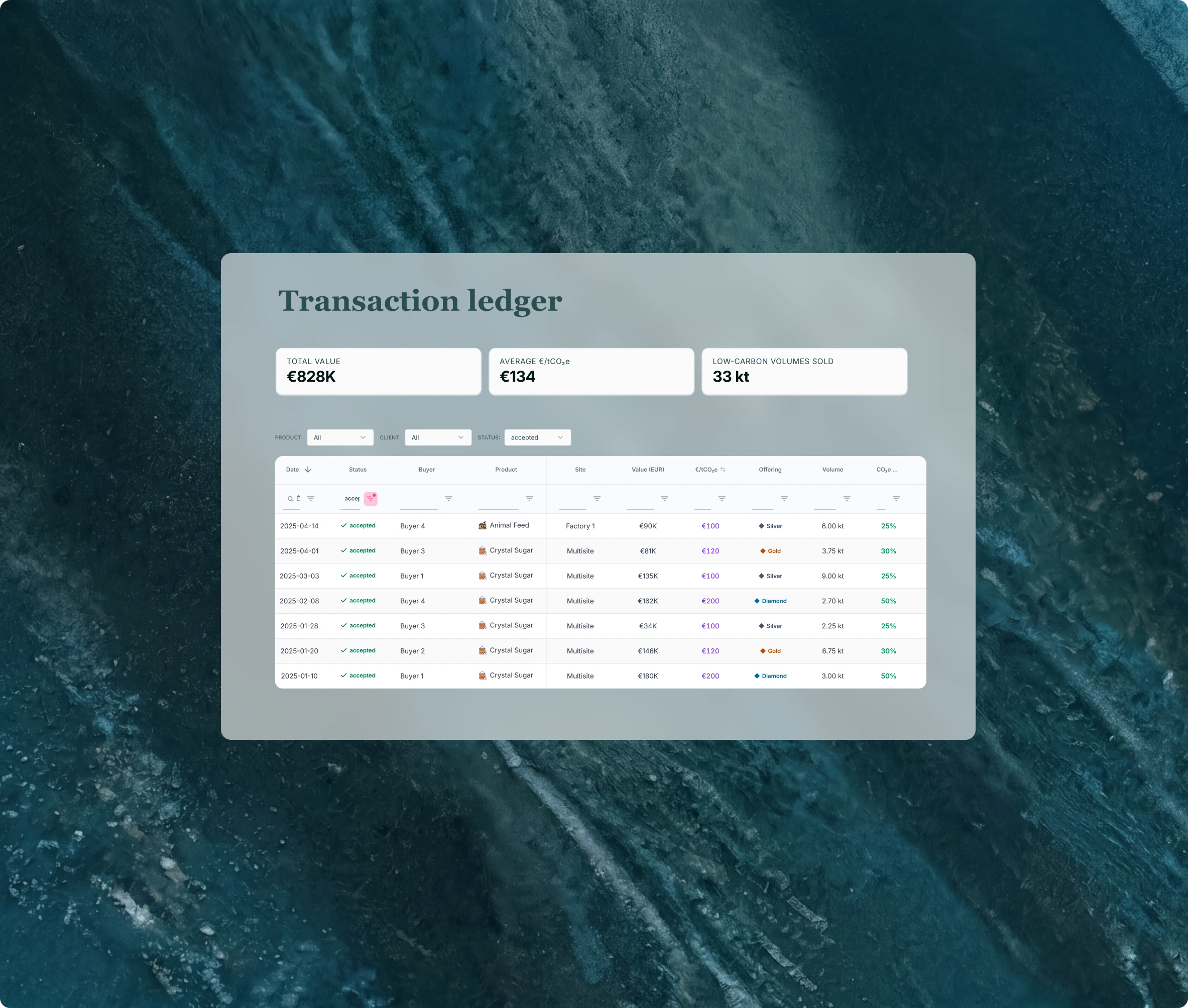
Transaction Ledger
Log every transaction on a secured ledger. Provide customers with the evidence needed to prevent double counting and support claim review.
Inventory Management
Track which low-carbon product offerings are available to sell to each customer. Equip commercial teams to avoid any overselling.
Scarcity tracker
Show to your customers which offerings are in high-demand to create urgency.
It’s a good place to describe image
Revenue Optimization
Optimize your low-carbon offerings
Average product carbon footprints dilute the value of your reductions across your portfolio. Chain of custody allows you to break this down and structure differentiated offerings.
Capture verified reductions
Identify the parts of your supply that deliver the greatest reductions.
Build a competitive position
Structure those volumes into offerings customers are willing to buy.
Stay ahead of evolving standards
Align with GHG Protocol and SBTi developments.
Benefits
Build a system your customers can trust and use
Confidence
Move beyond blended data and ensure your system aligns with traceability requirements.
Customer Trust
Provide claims your customers can rely on and use in their own reporting.
Higher value reductions
Trace your emission reductions and channel them to the buyers who value them most.
Q&A
Questions, answered.
What is the difference between product carbon footprints (PCF) and physical traceability?
Product carbon footprints measure emissions. Physical traceability links those emissions to real supply chains, ensuring a clear connection between the product and the reduction.
Can we transfer reductions without physical traceability?
Yes. Market-based mechanisms can be used where physical traceability is not possible. These must be reported separately from Scope 3 supply chain reporting.
What data sources do you use?
We connect multiple data sources across your business: - Procurement data: what enters your supply chain. - Production data: how materials are processed. - Commercial data: where demand for low-carbon supply exists. - Carbon data: existing PCFs or new calculations where needed.
How long does it take to get started?
A pilot can typically be set up within a few months, depending on data availability and scope. This allows you to test the system and demonstrate early results.







.svg)
